First Issue 1988
Second Issue 1992
Second Issue Re-etched 1994
Third Issue 1997
(This is a simplified sorting guide, Paper and gum types are not illustrated.)
The simplest way to determine these issues is by examining the Queen’s Head.
On the first issue 1988 it is engraved in the same colour as the stamp.
In the second issue 1992 the Queens head is in gold ink with “Diamond” shaped spaces.
In the second issue Re-etched 1994 the Queens head is in gold with square shaped spaces.
The Third Issue 1997 The Queens head is solid gold in irridescent ink, which has a colour shift when looked at obliquely.
There are other differences, the Second issue re-etched has strengthened lines and a darker image in the re-etched issue.
The Third issue has the Elliptical perforation printed above the 10th perfporation from the bottom (9th from the top) In the second issues it is placed 9th perforation from the botton.
There are other differences in paper and gum types, but not shown here in the simplified identifier. However they are listed under the issues below.
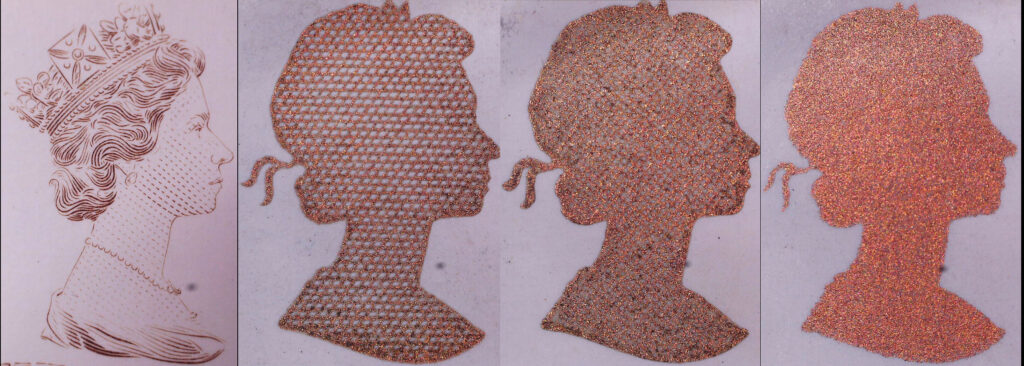
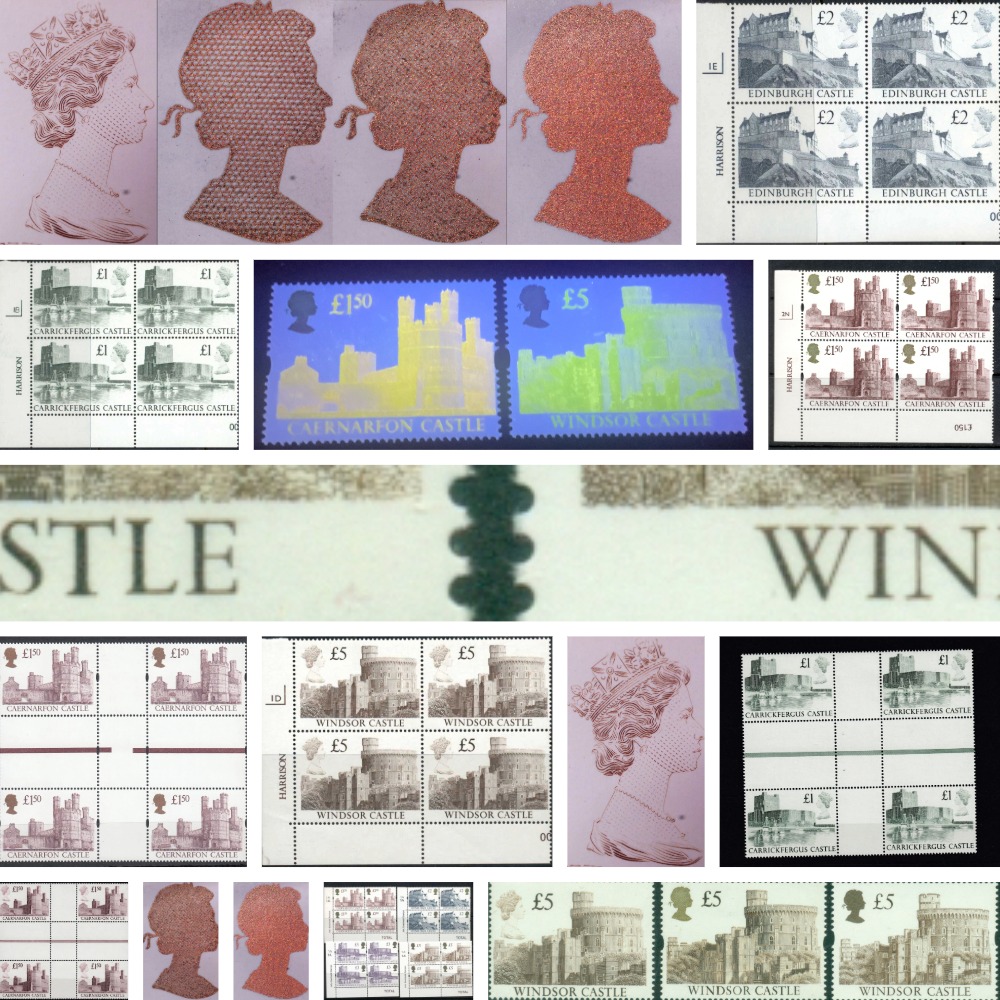
The Four Queens Head types in order. Over inking on the two second issues can make the difference obscure, a strong magnifying glass and good light is required.
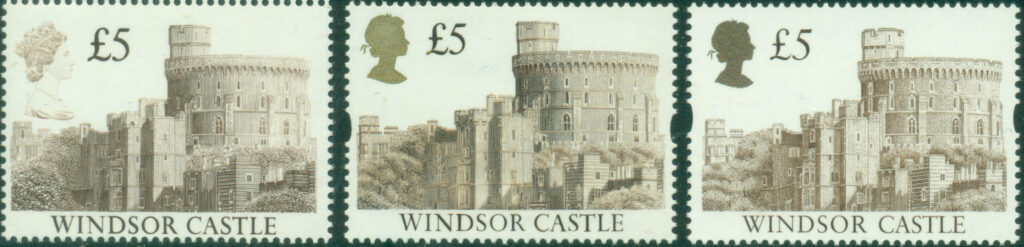
The 3 perforation types, First issue, 2nd issue Harrison, 3rd issue Enschede
First Issue 1988
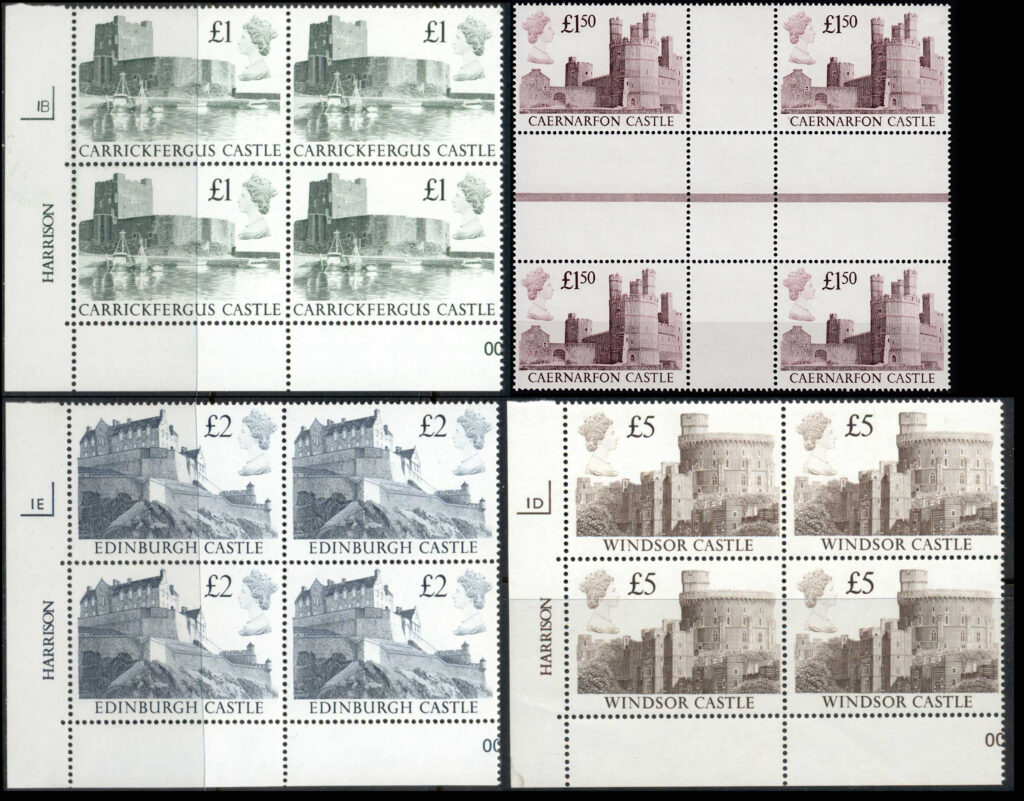
Castles – First Issue 1988
The stamps were recess-printed.
The sheets of 100 are divided by horizontal and vertical gutters into four panes of 25 (5 x 5), the stamp-size centre gutter containing a ‘Jubilee line’ of colour.
Plate numbers appear by the second stamp up on the bottom left-hand corner. The paper is FCP/DEX.
The £1.50 and £2 occurred on a highly glazed, fairly opaque paper in noticeably paler shades.
The £1 value exists on a slightly less glazed paper. This is distinctive in its yellowish green colour.
Harrison printings. Recess. Perf. 15 x 14.
1988 October 18 £1 Deep green Carrickfergus Castle
1990 0? 0? £1 Yellowish green, Carrickfergus Castle glazed paper with reduced OBA
1988 October 18 £1.50 Plum Caernarfon Castle
1990 0? 0? £1.50 Pale plum, Caernarfon Castle highly glazed paper, low OBA
1988 October 18 £2 Indigo Edinburgh Castle
1990 0? 0? £2 Pale indigo, Edinburgh Castle highly glazed paper, low OBA
1988 October 18 £5 Sepia Windsor Castle.
Castles – Second Issue
In March 1992, the Post Office released enhanced versions of the Castle series.
The most prominent changes featured an elliptical perforation on each vertical edge of the stamp and a revised Queen’s head.
The ink used for the bulk of the design incorporates a fluorescent additive, which when viewed under ultra-violet light, glows bright yellow-green on £1, £2 and £5 values and yellow-orange on the £1.50
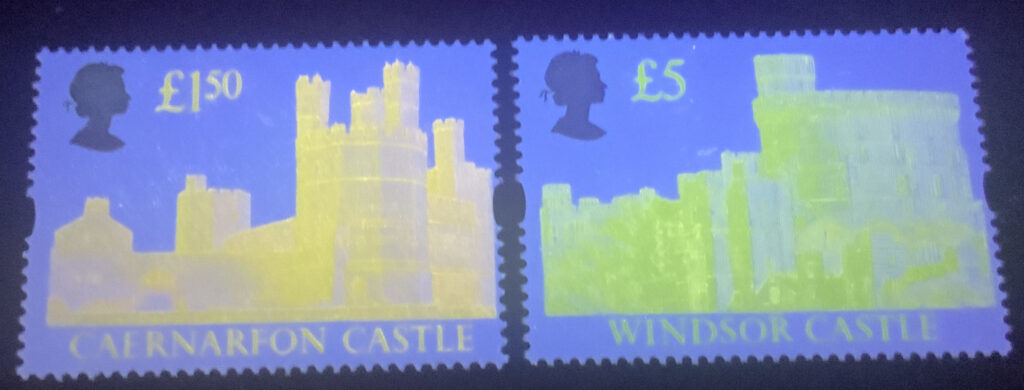
OBA Free Paper (OFNP). This was the first issue to use paper without optical brighteners.The paper is very dull with no trace of fluorescence, with no phosphor coating and Dextrin gum.
Optically Variable Ink (OVI). This is the first instance of this ink, and changes colour from gold, when viewed face on, to green, when tilted to the light.
Elliptical perforations. These appear halfway down each vertical line of perforations and occupy the space of three conventional holes.
Source. Plate numbers act as a very useful guide to the source of the numerous different paper and gum variations found on this issue.
Harrison Printings. 1. Intaglio. Perf 15 x 14 OFNP/DEX Queen’s head in profile in optically variable ink(diamond spaces)
1992 March 24 £1 Deep green Carrickfergus Castle White paper from Plates : 1A; 1B; 1C; 1D; 1H; 1I; 1J; 1K; 1L; 1M; 1O; 1P; 1Q; 1R; 1S
1993 March 0? £1 Deep green, Carrickfergus Castlle Cream paper from Plates : 1R; 1T; 1U; 2A; 2B; 2C; 2D; 2E; 2F; 2G; 2H; 2I; 2K; 2L
1992 March 24 £1.50 Plum Caernarfon Castle White paper from Plates : 2A; 2B; 2C; 2D; 2H; 2I; 2J; 2K; 2L; 2M; 2N; 2O; 2P
1992 December 0? £1.50 Bright plum, Caernarfon Castle Cream paper from Plates : 2N; 2O; 2P; 2Q; 2R; 2S; 2T; 2U; 2V; 2X; 2Y; 2Z; 2AA
1992 March 24 £2 Indigo Edinburgh Castle White paper from Plates : 2A; 2B; 2C; 2D; 2E; 2I; 2L; 2M; 2N; 2O; 2P; 2Q; 2R; 2S; 2U; 2V
1993 January 0? £2 Indigo Edinburgh Castle Cream blued paper from Plates : 2B
1993 Feb 0? £2 Indigo Edinburgh Castle Cream paper from Plates : 2P; 2Q; 2S; 2T; 2U; 2V; 2W; 2X; 2Z; 2BB; 2CC; 2DD; 2EE
1992 March 24 £5 Sepia Windsor Castle White paper from Plates : 2A; 2B; 2C; 2D
1993 March 0? £5 Sepia Windsor Castle Cream paper from Plates : 4B; 4D; 4E; 4F; 4G
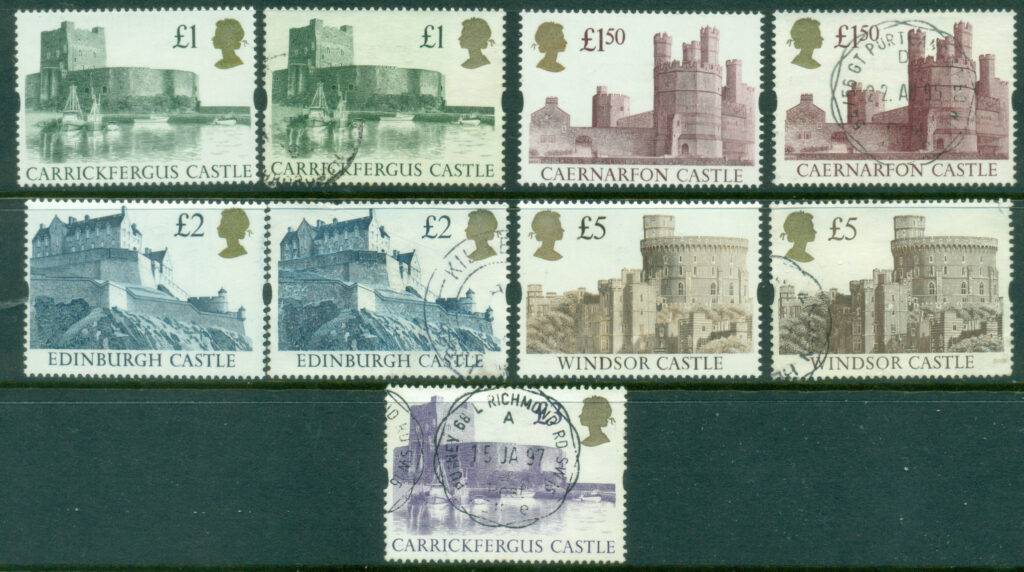
Both issues, Left image first issue, second image re-etched issue.
1994 Re-etched Values
Beginning in August 1994, all four original values were introduced in re-etched versions, enhanced by computer re-etching. The engraving of the illustrations, particularly on the £1.50 and £5 values, appears much deeper, resulting in less subtlety in design and leaving less contrast between shadow and light. Due to this the stamps appear much deeper in colour. The best way, though, to identify the re-etched versions is through examination of the Queen’s head. This is made up of a series of smaller square shaped cells, whereas the original version had consisted of diamond shaped cross hatching as shown above.
In 1995, a new value castle was released – £3 in the Carrickfergus castle design, but in a violet colour.
Paper colour. Like the 1992 issues, the re-etched values come in both cream (initial stocks) and white (later issues) versions.
Translucent paper. In addition to paper and gum colour, there is a further variable – the translucency of the papers, which range from very opaque to ultra-translucent.
There are three types – Opaque, Trans (translucent) and Ultra (ultra-translucent).
PVA Layflat gum. In common with low value issues, Harrisons introduced a layflat version of PVA gum in early 1996, with dextrin removed. This is more matt in appearance and has less of the familiar blue tint that was added to dextrin gum.
Harrison Printings. 2. Intaglio. Perf 15 x 14. OFNP/DEX Queen’s head in profile in optically variable ink(square spaces)
1994 January 01 £1 Deep green Carrickfergus Castle DEX Cream Opaque Paper ex Plates: 3A; 3B; 3C; 3E; 3F; 3G; 3H; 3I; 3J
1995 March 0? £1 Deep green Carrickfergus Castle DEX Cream Trans Paper ex Plates : 3F; 3G; 3H; 3I; 3J; 3K
1994 October 26 £1.50 Deep plum Caernarfon Castle DEX Cream Opaque Paper ex Plates: 2DD; 2EE; 2FF; 2GG
1995 April 0? £1.50 Deep plum Caernarfon Castle DEX Cream Trans Paper ex Plates : 2II; 2LL; 4A; 4B; 4C; 4D; 4E; 4F; 4G; 4H; 4I; 4J
1995 September 15 £1.50 Deep plum Caernarfon Castle DEX White Trans Paper ex Plates : 4H; 4I; 4J; 4K; 4L; 4M
1995 October 0? £1.50 Deep plum Caernarfon Castle DEX White Ultra Paper ex Plates : 4L
1995 October 0? £1.50 Bright plum Caernarfon Castle DEX White Ultra Paper ex Plates :: 4J
1996 March 05 £1.50 Deep plum Caernarfon Castle PVA White Trans Paper ex Plates : 4J; 4L; 4M; 4N; 4O; 4P
1996 March 0? £1.50 Deep plum, Caernarfon PVA Cream Opaque Paper very heavy paper ex Plates : 4J; 4L; 4M
1994 November 15 £2 Deep indigo Edinburgh Castle DEX Cream Opaque Paper ex Plates : 3A; 3B; 3C; 3D; 3E; 3F; 3H; 3I; 3J; 3L
1995 March 0? £2 Deep indigo Edinburgh Castle DEX Cream Trans Paper ex Plates : 3E; 3I; 3J; 3K; 3L; 4A; 4B; 4C; 4D; 4E; 4F
1995 November 0? £2 Deep indigo Edinburgh Castle DEX White Trans Paper ex Plates : 4D; 4E; 4F
1996 May 02 £2 Deep indigo Edinburgh Castle PVA White Trans Paper ex Plates : 4C; 4F; 4G; 4I; 4J; 4K
1996 May 0? £2 Deep indigo Edinburgh Castle PVA White Ultra Paper ex Plates : 4F; 4G
1995 August 22 £3 Greyish violet Carrickfergus Castle DEX Cream Trans Paper ex Plates : 1A; 1B; 1C; 1D; 1E; 1G; 1I; 1J; 1K; 1L; 1M
1995 August 22 £3 Greyish violet Carrickfergus Castle DEX White Trans Paper ex Plates : 1A; 1B; 1D; 1E; 1G; 1H; 1I; 1J; 1K; 1L; 1M
1997 Feb 27 £3 Greyish violet Carrickfergus Castle PVA White Trans Paper ex Plates : 1L; 1M
1994 August 0? £5 Dark brown Windsor Castle DEX Cream Opaque Paper ex Plates : 5B; 5C; 5F; 5G; 5O; 5P
1995 June 0? £5 Dark brown Windsor Castle DEX Cream Trans Paper ex Plates : 7B; 7C
1995 December 06 £5 Dark brown Windsor Castle DEX White Trans Paper ex Plates : 7D; 7E
1996 September 17 £5 Dark brown Windsor Castle PVA White Trans Paper ex Plates : 7D; 7E
Third Issue Enschedé Printings. Intaglio/Silkscreen. Perf 15 x 14 PVA gum
Harrison lost the contract to print high values in 1997. In their place, Royal Mail awarded the contract to Joh Enschedé of the Netherlands.The castles were re-engraved by Enschedé.
Queen’s Head. The most significant difference between the two types is the printing of the Queen’s head as a solid, rather than being made up of a series of cross-hatchings. This is the easiest way to distinguish the two printings.
Typeface. The type face used for the Castle inscription is exceedingly well matched, with one glaring exception. On the Enschedé £5 value, the letter “W” in Windsor is the double cross V type “W”, whereas on the Harrison printing it is the conventional “W”.

Ellipse. Although both Harrison and Enschedé printings are perforated 15 x 14, the ellipse on the left and right side of the stamps differ. On Harrison stamps it is placed above the 9th perforation from the bottom of the stamp (10 from the top), whereas on Enschedé versions it is above the 10th perf from the bottom (9 from the top).
Gum. The Enschedé PVA gum is colourless
Paper. The OFNP paper used on Enschedé values has a highly glazed finish.
Engraving. The engraving on Enschedé stamps is lighter than Harrison issues, so they appear slightly paler in shade, but with less contrast between the dark and light portions of the design. As a consequence fine detail is more visible.
The solid QEII head and the location of the elliptical perf are enough to identify this issue.
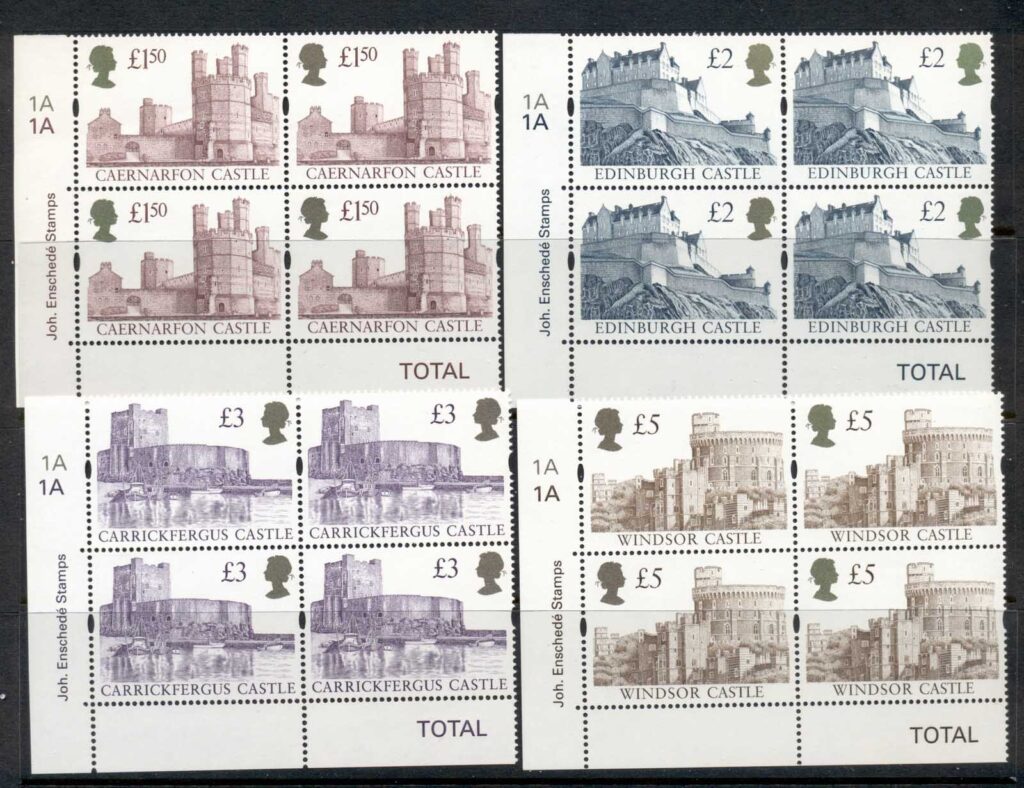
1997 September 29 £1.50 Deep plum Caernarfon Castle
1997 September 29 £2 Deep indigo Edinburgh Castle
1997 September 29 £3 Greyish violet Carrickfergus Castle
1997 September 29 £5 Dark brown Windsor Castle